2026 Federal Student Loan Interest Rate Forecast: What Borrowers Need to Know Now

Understanding the 2026 federal student loan interest rate forecast is crucial for borrowers to plan their finances effectively and navigate future educational debt.
Preparing for the future of your student loan debt is paramount, and understanding the 2026 federal student loan interest rate forecast is a key step for every borrower to effectively manage their financial journey.
The mechanics of federal student loan interest rates
Federal student loan interest rates are not static; they are determined annually by a formula set by Congress, typically tied to the 10-year Treasury note yield. This mechanism ensures a degree of predictability, yet it also means rates can fluctuate based on broader economic conditions. Understanding this foundational process is essential for anticipating future changes.
How rates are set annually
Each spring, specifically by June 1st, the interest rates for new federal student loans disbursed for the upcoming academic year are announced. These rates are fixed for the life of the loan. The formula usually involves adding a statutory add-on to the high yield of the 10-year Treasury note auction held in May.
- Direct subsidized loans: Typically have the lowest add-on.
- Direct unsubsidized loans (undergraduate): A slightly higher add-on than subsidized loans.
- Direct unsubsidized loans (graduate/professional): Have a higher add-on, reflecting increased borrowing limits.
- Direct PLUS loans: Both parent PLUS and grad PLUS loans carry the highest add-on.
This structure means that while the base rate (10-year Treasury note) moves, the additional percentage is fixed by law, creating different tiers of interest rates for various loan types. Borrowers should always be aware of which loan type they are accepting and its corresponding rate.
The system aims to balance affordability for students with the need to cover administrative costs and potential defaults. While the base rate is market-driven, the fixed add-ons provide a level of stability. This blend of market forces and legislative decision-making is crucial to grasp for anyone seeking to understand the trajectory of student loan costs.
In conclusion, the annual determination of federal student loan interest rates is a transparent, formulaic process. It’s rooted in economic benchmarks and legislative mandates, providing a clear framework for how these crucial financial obligations are priced. Familiarity with this process empowers borrowers to make informed decisions.
Current economic indicators influencing 2026 rates
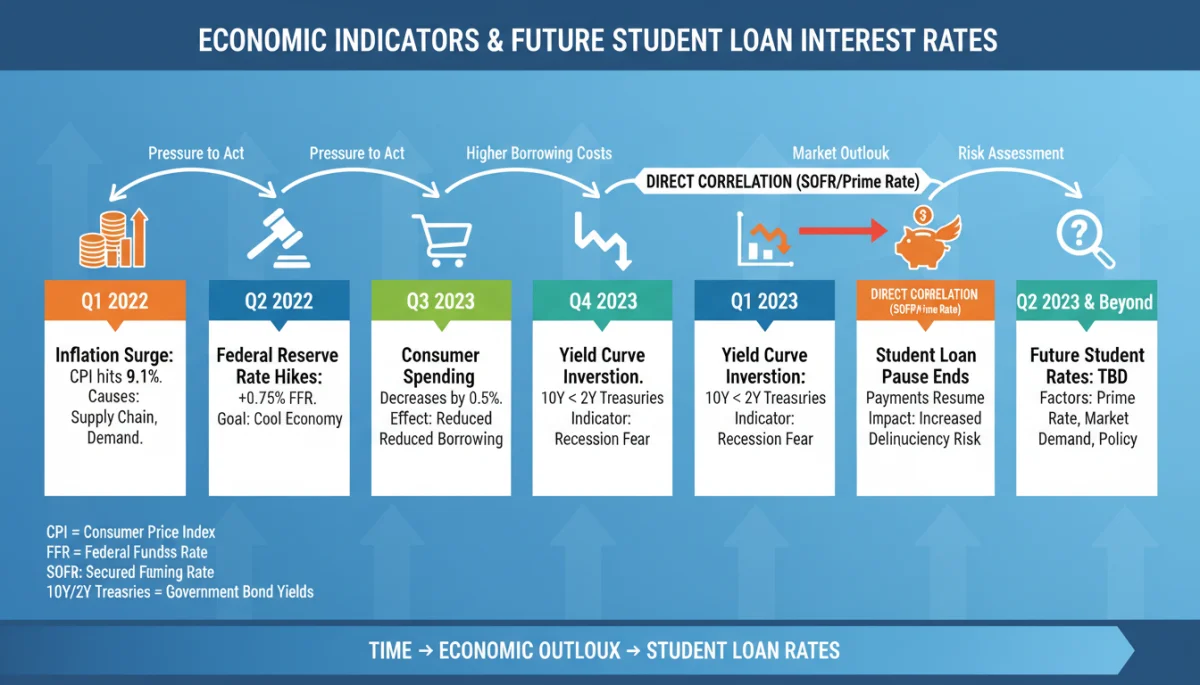
Forecasting federal student loan interest rates for 2026 requires a keen eye on current and projected economic indicators. Factors such as inflation, Federal Reserve policy, and overall economic growth play significant roles in shaping the 10-year Treasury note yield, which directly impacts student loan rates.
Inflation and the Federal Reserve’s stance
Inflation is a primary driver of interest rate decisions. When inflation is high, the Federal Reserve typically raises its benchmark interest rate to cool down the economy. While the Fed’s rate isn’t directly the student loan rate, it influences the broader bond market, including the 10-year Treasury note. A sustained period of inflation could lead to higher Treasury yields and, consequently, higher student loan rates in 2026.
Conversely, if inflation moderates or the economy slows significantly, the Federal Reserve might ease its monetary policy. This could lead to lower Treasury yields. Economic forecasts for 2025 and 2026 will be critical in determining the Fed’s likely actions and their ripple effects on student loan rates.
Government spending and borrowing also exert pressure on Treasury yields. Increased government borrowing can drive up demand for bonds, potentially increasing yields. Geopolitical events and global economic stability can also introduce volatility into the bond market, making precise predictions challenging.
Understanding these interconnected economic forces is vital. Borrowers should monitor reports from the Federal Reserve, the Congressional Budget Office, and reputable financial institutions for insights into the economic landscape. These forecasts will provide the most accurate picture of what to expect for student loan rates in the coming years.
In summary, the interplay of inflation, Federal Reserve actions, and broader economic stability forms the bedrock of 2026 interest rate predictions. Keeping abreast of these indicators is crucial for any borrower planning their financial future.
Potential scenarios for 2026 interest rates
Given the various economic factors at play, several potential scenarios for 2026 federal student loan interest rates emerge. These scenarios range from a continuation of current trends to more significant shifts, each with different implications for borrowers.
Scenario 1: Moderate increase
Under this scenario, the economy continues its gradual growth, with inflation remaining somewhat elevated but manageable. The Federal Reserve might implement a few modest rate hikes or maintain current rates, preventing a sharp rise in Treasury yields. In this case, new federal student loan interest rates for 2026 could see a slight increase, perhaps by 0.25% to 0.50% across different loan types, reflecting continued economic stability and inflation concerns.
Scenario 2: Significant increase
This scenario envisions a more aggressive inflationary environment, perhaps fueled by supply chain disruptions or robust consumer demand. The Federal Reserve would likely respond with more substantial rate hikes to curb inflation, leading to a noticeable jump in the 10-year Treasury yield. Consequently, 2026 student loan rates could climb more significantly, potentially by 0.75% to 1.50% or more. This would make borrowing more expensive for new students and could impact refinancing decisions for existing borrowers.
Scenario 3: Stable or slight decrease
In a less likely but possible scenario, economic growth could slow considerably, or even enter a mild recession, leading to a decrease in inflationary pressures. The Federal Reserve might then consider cutting rates to stimulate the economy. This environment would likely result in stable or even slightly lower 10-year Treasury yields, which could translate to stable or marginally lower federal student loan interest rates for 2026. This would offer some relief to new borrowers and those considering consolidation.
Each of these scenarios highlights the dynamic nature of interest rate forecasts. Borrowers should consider their personal financial situation against these possibilities and prepare for different outcomes. Flexibility in financial planning will be a significant asset.
To conclude, 2026 interest rates could follow various paths depending on economic conditions. Preparing for a range of outcomes, from moderate increases to potential stability, is the most prudent approach for future borrowers.
Impact on different borrower types
The forecast for 2026 federal student loan interest rates will have varying impacts on different borrower types. Understanding these distinctions is crucial for both current students and those considering higher education.
New borrowers entering college in 2026
For students starting college in the 2026-2027 academic year, the announced interest rates will directly apply to their new federal loans. Higher rates mean a greater total cost of borrowing over the life of the loan. This could influence their choice of institution, major, or even the amount of debt they are willing to accrue. It emphasizes the importance of maximizing grants, scholarships, and federal work-study opportunities to minimize reliance on loans.
They should also be acutely aware of the differences between subsidized and unsubsidized loans. Subsidized loans do not accrue interest while the student is in school, during grace periods, or during deferment, offering a significant advantage over unsubsidized loans, which begin accruing interest immediately.
Current students with existing federal loans
Students who already have federal student loans will not see their existing fixed interest rates change. However, if they take out new federal loans for the 2026-2027 academic year, those new loans will carry the rates announced for that year. This could result in having multiple loans with different interest rates, complicating repayment strategies.
For these borrowers, understanding the average interest rate across all their loans becomes important. They might consider consolidation after graduation to simplify repayment, though consolidation often means losing some borrower benefits and potentially locking in a higher rate if done at an unfavorable time.
Recent graduates and those in repayment
For recent graduates or those already in repayment, the 2026 forecast primarily impacts their future decisions, such as whether to pursue further education that requires new loans. It also influences the broader economic environment, which could affect job prospects and earning potential, indirectly impacting their ability to repay existing loans.
While their existing federal loan rates are fixed, they might be watching the market for potential refinancing opportunities with private lenders. However, private refinancing means losing federal loan benefits like income-driven repayment plans and potential forgiveness programs, a trade-off that requires careful consideration.
In conclusion, 2026 interest rate changes will affect new borrowers most directly, but current students and those in repayment also need to understand the broader implications for their financial planning and future educational pursuits.
Strategies for managing student loan debt in 2026
Regardless of the 2026 federal student loan interest rate forecast, borrowers have several proactive strategies they can employ to manage their debt effectively. Early planning and informed decision-making are key to minimizing costs and achieving financial freedom.
Maximizing federal loan benefits
Federal student loans come with a suite of borrower protections and repayment options that are unavailable with private loans. Understanding and utilizing these benefits can significantly ease the burden of repayment, especially if rates are higher in 2026.
- Income-driven repayment (IDR) plans: These plans adjust monthly payments based on income and family size, potentially leading to lower payments and eventual loan forgiveness after 20 or 25 years of qualifying payments.
- Deferment and forbearance: These options allow borrowers to temporarily pause payments during periods of financial hardship, although interest may continue to accrue on unsubsidized loans.
- Public Service Loan Forgiveness (PSLF): For borrowers working in qualifying public service jobs, the remaining balance on their Direct Loans may be forgiven after 120 qualifying monthly payments.
It’s crucial to explore these options thoroughly and enroll in the plans that best suit your financial situation. Don’t assume you have to struggle with high payments; federal programs are designed to offer flexibility.
Considering refinancing and consolidation
For borrowers with existing federal loans, private refinancing could be an option if interest rates are favorable. However, as mentioned, this means forfeiting federal benefits. Consolidation, on the other hand, combines multiple federal loans into a single Direct Consolidation Loan with a new fixed interest rate, which is the weighted average of the original loans’ rates, rounded up to the nearest one-eighth of a percentage point. This can simplify repayment but may not always lower the interest rate.
Before considering either, carefully weigh the pros and cons. Consult with a financial advisor to understand the long-term implications for your specific situation. The decision to refinance or consolidate should be based on a comprehensive understanding of your financial goals and risk tolerance.
In conclusion, proactive engagement with repayment options, careful consideration of refinancing, and a full understanding of federal loan benefits are paramount for effectively managing student loan debt in 2026 and beyond.
The role of legislative changes and policy
Beyond economic indicators, legislative changes and policy decisions in Washington D.C. can significantly impact federal student loan interest rates and the broader student loan landscape. Congress has the authority to modify the interest rate formula or introduce new programs that affect borrowers.
Past legislative impacts
Historically, Congress has intervened multiple times to adjust student loan interest rates or introduce new repayment flexibilities. For example, during economic downturns, there have been periods of interest rate freezes or temporary reductions. The COVID-19 pandemic also saw unprecedented pauses in interest accumulation and payments.
These past actions demonstrate that while the formula for setting rates is established, it is not immutable. Political will and changing economic priorities can lead to adjustments that directly benefit or challenge borrowers. Monitoring legislative discussions around higher education funding and student debt relief is therefore crucial.
Future policy considerations for 2026
As 2026 approaches, several policy areas could be subject to legislative debate:
- Interest rate formula reform: There could be proposals to change how rates are calculated, perhaps delinking them from the 10-year Treasury note or capping them at a lower level.
- Loan forgiveness programs: Discussions around expanding or modifying existing loan forgiveness programs, or introducing new ones, could continue.
- Affordability initiatives: New legislation aimed at making college more affordable, which could indirectly reduce the need for high-interest loans, might emerge.
These potential policy shifts add another layer of complexity to forecasting 2026 rates. While economic fundamentals drive the initial projections, legislative action can override or significantly alter those outcomes. Borrowers should stay informed about political developments that could influence their financial obligations.
In conclusion, legislative changes and policy decisions are powerful forces in the student loan environment. Keeping an eye on governmental actions is as important as tracking economic indicators for a complete understanding of future rates and borrower support.
Preparing for the 2026 student loan environment
Given the dynamic nature of economic forecasts and potential policy shifts, preparing for the 2026 student loan environment requires a comprehensive and adaptable approach. Borrowers, whether prospective or current, should focus on informed decision-making and proactive financial planning.
Actionable steps for prospective students
If you plan to attend college in 2026 or later, start by researching financial aid options beyond loans. Maximize grants, scholarships, and institutional aid to reduce your borrowing needs. Understand the different types of federal loans and their respective interest rate structures. Create a realistic budget for college expenses and consider how potential interest rate changes might affect your future repayment capacity.
It’s also wise to complete the Free Application for Federal Student Aid (FAFSA) as early as possible each year, as some aid is awarded on a first-come, first-served basis. Don’t be afraid to compare financial aid packages from different schools, as they can vary significantly.
Advice for current borrowers
For those already carrying federal student loan debt, regularly review your loan portfolio. Understand the interest rate on each loan and explore federal repayment plans like Income-Driven Repayment (IDR) if you anticipate financial challenges. Keep an emergency fund to cover unexpected expenses, which can prevent you from defaulting on loans.
Stay informed about economic trends and legislative changes that could impact student loans. Consider making extra payments on your loans, especially those with higher interest rates, if your budget allows. Even small additional payments can significantly reduce the total interest paid over the life of the loan.
Finally, avoid scams. Only trust information from official sources like the U.S. Department of Education or your loan servicer. Be wary of companies promising quick fixes or charging fees for services that are free through federal programs.
In summary, preparing for 2026 involves a combination of financial literacy, strategic planning, and continuous monitoring of economic and policy developments. Being proactive will empower you to navigate the student loan landscape with confidence.
| Key Point | Brief Description |
|---|---|
| Rate Setting | Federal loan rates are tied to the 10-year Treasury note, set annually by Congress. |
| Economic Factors | Inflation, Fed policy, and economic growth heavily influence Treasury yields and future rates. |
| Borrower Impact | New borrowers face rates directly; existing borrowers’ new loans may have different rates. |
| Management Strategies | Utilize federal benefits, consider consolidation, and stay informed about policy changes. |
Frequently asked questions about 2026 student loan rates
No, federal student loan interest rates are fixed for the life of the loan once disbursed. Your current loans will maintain their original rates. Only new federal loans taken out for the 2026-2027 academic year will be subject to the rates announced in 2026.
The primary economic factors influencing 2026 federal student loan interest rates are inflation trends, the Federal Reserve’s monetary policy decisions, and the yield of the 10-year Treasury note. A stronger economy with higher inflation typically leads to higher rates.
Refinancing federal loans into a private loan means forfeiting federal benefits like income-driven repayment and forgiveness programs. While you might secure a lower rate, carefully weigh these lost protections against potential savings. It’s a personal decision based on your financial stability and risk tolerance.
To prepare, focus on minimizing new borrowing, maximizing grants and scholarships, and understanding federal repayment options. For existing loans, consider making extra payments if possible, and explore income-driven repayment plans to manage monthly costs effectively.
Yes, Congress has the authority to modify the federal student loan interest rate formula or introduce new policies that could affect rates or borrower benefits. Monitoring legislative developments related to higher education funding and student debt is advisable.
Conclusion
Navigating the future of federal student loan interest rates requires vigilance and a proactive approach. While precise predictions for 2026 remain subject to evolving economic conditions and potential legislative actions, understanding the underlying mechanisms and potential scenarios empowers borrowers to make informed decisions. By staying abreast of economic indicators, leveraging federal loan benefits, and planning strategically, both prospective and current students can effectively manage their educational debt and secure their financial well-being.