2026 Federal Student Aid: 15% College Funding Impact

New federal student aid policies in 2026 are poised to significantly reshape college funding, potentially altering financial assistance by up to 15% for students across the United States.
The landscape of higher education finance is on the cusp of a significant transformation. Starting in 2026, new federal student aid policies are set to redefine how millions of students fund their college education, with potential shifts that could impact your financial assistance by as much as 15%. This impending change demands careful attention from students, parents, and educational institutions alike, as understanding these reforms is paramount to navigating the future of college affordability.
understanding the upcoming 2026 federal student aid changes
The year 2026 marks a pivotal moment for federal student aid programs, ushering in a series of reforms designed to streamline processes, enhance equity, and potentially recalibrate funding allocations. These changes stem from ongoing legislative efforts to simplify the Free Application for Federal Student Aid (FAFSA) and adjust the methodologies used to determine a student’s financial need.
Historically, the federal student aid system has been complex, often leading to confusion and missed opportunities for eligible students. The forthcoming policies aim to address these challenges by introducing a more intuitive application process and refining the criteria for aid eligibility. This could mean a more direct path to understanding and securing financial assistance for many families, but it also necessitates a proactive approach to learning the new rules.
the simplified FAFSA and its implications
- Reduced Questions: The updated FAFSA will feature fewer questions, making it quicker and easier to complete for applicants.
- Direct Data Exchange: Integration with IRS data will allow for direct transfer of tax information, reducing manual entry errors and verification burdens.
- New Terminology: Familiar terms like ‘Expected Family Contribution’ (EFC) will be replaced by ‘Student Aid Index’ (SAI), reflecting a different calculation methodology.
The simplification of the FAFSA is a cornerstone of the 2026 reforms. While intended to broaden access and reduce barriers, it also introduces new calculations that could alter a student’s eligibility for various aid types. Understanding how your family’s financial situation translates into the new Student Aid Index is crucial for anticipating your potential funding.
In essence, the 2026 reforms represent a significant overhaul of the federal student aid system. While the overarching goal is to make college more accessible and affordable, the specific mechanisms through which this will occur will require careful examination by all stakeholders. Preparing for these shifts now can help mitigate any unexpected impacts on your college funding plans.
impact on Pell grants and federal loan programs
The 2026 federal student aid policies are expected to have a notable effect on two of the most critical components of college funding: Pell Grants and federal loan programs. These changes are designed to expand access to free aid for low-income students while also refining the terms and conditions of federal loans.
Pell Grants, often considered the foundation of federal student financial aid, are slated for adjustments that could significantly increase the number of eligible recipients and the maximum award amounts. This expansion aims to provide more substantial support to students from the lowest-income households, potentially reducing their reliance on loans.
expanded Pell grant eligibility and award amounts
- Increased Access: More students from low-income backgrounds are expected to qualify for Pell Grants due to revised eligibility formulas.
- Higher Maximum Awards: The maximum Pell Grant award could see an increase, providing greater financial relief to recipients.
- Automatic Qualification: Some students, based on specific income thresholds or receipt of other federal benefits, may automatically qualify for the maximum Pell Grant.
Beyond grants, federal loan programs will also experience modifications. While the core structure of subsidized and unsubsidized loans will likely remain, there may be changes to interest rate caps, repayment options, or even loan limits. These adjustments could influence how much students borrow and their long-term repayment obligations.
Understanding the nuances of these changes is vital for financial planning. An increase in Pell Grant eligibility could drastically reduce the need for loans for some students, while changes to loan terms might necessitate a different borrowing strategy for others. Staying informed about these specific program adjustments will be key to maximizing your financial aid package.
how the student aid index (SAI) replaces EFC
One of the most fundamental shifts under the 2026 federal student aid policies is the replacement of the Expected Family Contribution (EFC) with the new Student Aid Index (SAI). This change is far more than a mere renaming; it signifies a complete overhaul of how a student’s financial need is calculated, potentially altering who qualifies for aid and how much they receive.
The EFC, a long-standing metric, often faced criticism for its complexity and perceived inequities. The SAI aims to be a more equitable and transparent measure, focusing on a student’s ability to pay for college rather than a broad family contribution. This new index will be the primary determinant for federal, and often institutional, financial aid eligibility.
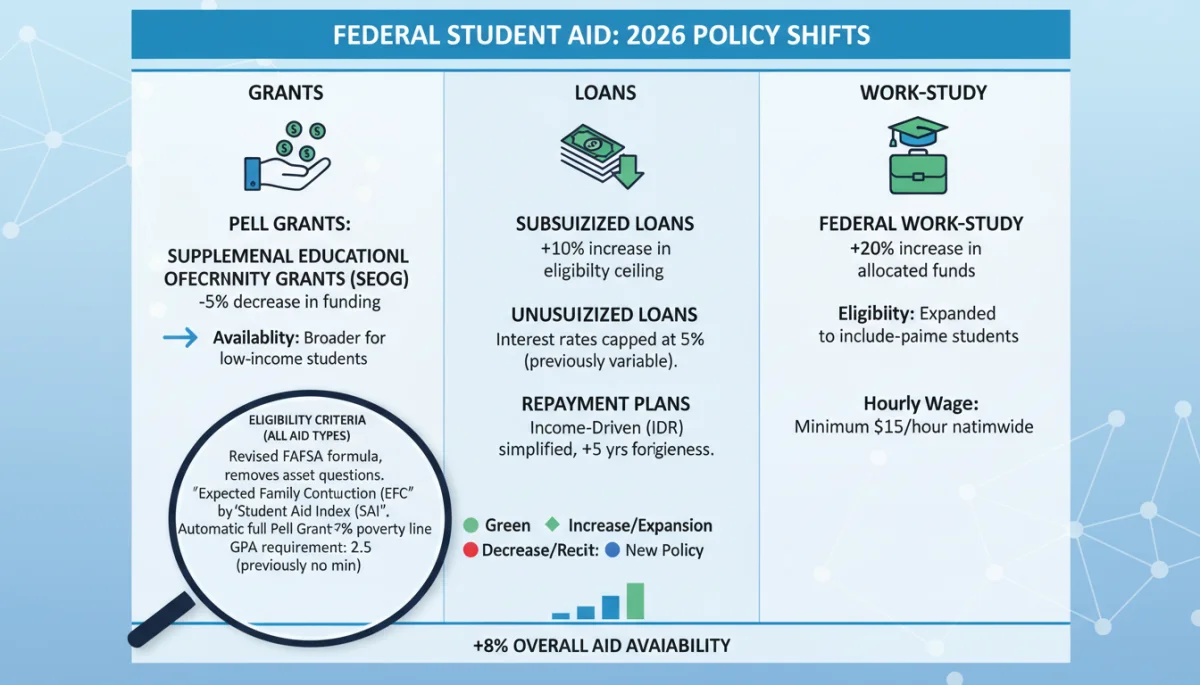
key differences between EFC and SAI calculations
- Income Protection Allowance: The SAI increases the income protection allowance, meaning more income is shielded from the calculation, potentially lowering the SAI for many families.
- Family Size Consideration: The new formula gives greater weight to family size, especially for larger families, which could result in a lower SAI.
- Exclusion of Family Farms/Small Businesses: The value of family farms and small businesses will no longer be considered as assets in the SAI calculation, a significant change for many families.
The transition from EFC to SAI will have a direct impact on a student’s financial aid eligibility. A lower SAI generally translates to a higher demonstrated financial need, potentially leading to more grant aid and more favorable loan terms. Conversely, a higher SAI could mean less need-based aid. Families should familiarize themselves with the new formula and consider how their specific financial circumstances will be assessed under the SAI.
Ultimately, the SAI is designed to provide a clearer and fairer picture of a family’s financial capacity. While the intent is to simplify and improve the aid process, understanding this new calculation is essential for accurately forecasting your eligibility for federal student aid in 2026 and beyond.
strategies for maximizing your college funding in 2026
With the impending changes to federal student aid policies in 2026, students and families must adopt proactive strategies to maximize their college funding. The reforms present both challenges and opportunities, and a well-informed approach can make a significant difference in securing the necessary financial assistance.
Maximizing financial aid extends beyond simply filling out the FAFSA. It involves understanding the new rules, exploring all available avenues for funding, and making informed decisions about college choice and financial planning. Early preparation will be a critical factor in navigating the evolving landscape of college finance effectively.
proactive steps for students and families
- Understand the New FAFSA: Familiarize yourself with the simplified FAFSA and the new Student Aid Index (SAI) calculation. Use online resources and university financial aid offices for guidance.
- Estimate Your SAI: Utilize available online calculators that incorporate the new SAI methodology to get a preliminary estimate of your financial need. This can help you anticipate potential aid.
- Explore State and Institutional Aid: Federal aid is just one piece of the puzzle. Research state-specific grants, scholarships, and institutional aid programs, which may also be adjusting their policies in response to federal changes.
Beyond federal aid, actively seeking out scholarships from private organizations, community groups, and specific academic departments can significantly supplement your funding. These scholarships are often need-blind and can cover gaps left by federal and institutional aid. Additionally, considering colleges that meet a high percentage of demonstrated financial need can be a strategic move.
Effective financial planning for college in 2026 will require a holistic approach. By staying informed, being proactive in your applications, and exploring multiple funding sources, you can position yourself to maximize your federal student aid and other financial assistance, ensuring a smoother path to achieving your educational goals.
potential 15% shift: what it means for your aid package
The headline figure—a potential 15% shift in college funding—underscores the significant impact the 2026 federal student aid policies could have on individual aid packages. This percentage isn’t a universal increase or decrease, but rather an indication of the magnitude of change some students may experience, either positively or negatively, depending on their specific circumstances under the new Student Aid Index (SAI).
For some families, the revised FAFSA and SAI calculation, with its increased income protection allowances and changes to asset consideration, could lead to a lower SAI and thus a higher eligibility for need-based aid, including Pell Grants. This could translate to a substantial increase in their overall financial assistance, potentially by 15% or more.
factors influencing the 15% aid shift
- Income Level: Lower-income families, especially those previously on the cusp of Pell Grant eligibility, may see a significant positive shift due to increased income protection.
- Family Size: Larger families may benefit from the increased weighting of family size in the SAI calculation, leading to more aid.
- Asset Holdings: Families with small businesses or family farms, now excluded from asset calculations, could see a substantial reduction in their SAI, boosting their aid eligibility.
Conversely, some families might find their SAI increases under the new methodology, potentially reducing their eligibility for need-based federal student aid. This could be due to factors such as changes in how specific types of income are assessed or if their income protection allowance effectively decreases relative to their household size under the new rules. For these students, the 15% shift could represent a decrease in their aid package, necessitating a greater reliance on loans, scholarships, or out-of-pocket payments.
The 15% figure serves as a powerful reminder that the 2026 changes are not minor adjustments but a comprehensive reform with tangible consequences. It highlights the importance of individualized assessment and proactive planning to understand how these policies will specifically affect your family’s college funding outlook.
preparing for the future: resources and timelines
As the 2026 federal student aid policies draw nearer, proactive preparation is essential for students and families. Understanding the timeline for these changes and knowing where to access reliable resources will be crucial for navigating the transition smoothly and effectively securing college funding.
The Department of Education and various financial aid organizations are working to disseminate information and tools to help stakeholders adapt. Staying abreast of official announcements and utilizing educational resources will empower you to make informed decisions about your higher education financing.
key resources and important dates
- Official Federal Student Aid Website: The primary source for accurate and up-to-date information on FAFSA changes, SAI calculations, and program updates.
- College Financial Aid Offices: These offices are invaluable resources for personalized guidance on federal, state, and institutional aid, and how the new policies will impact their specific university.
- Non-Profit Financial Aid Organizations: Many organizations offer free workshops, counseling, and online tools to help families understand and apply for financial aid.
While the full implementation of all reforms is slated for 2026, some aspects, like the simplified FAFSA, may see earlier soft launches or preparatory guidance. It is important to monitor these timelines closely, especially if you have a student nearing college enrollment in the next few years. Beginning your research and planning now can alleviate stress and ensure you are well-positioned when the new policies take full effect.
Ultimately, preparing for the future of federal student aid involves continuous learning and engagement. By leveraging available resources and adhering to important timelines, you can effectively plan for college funding and ensure that the 2026 policy shifts work in your favor, or at least that you are well-equipped to mitigate any potential challenges.
| Key Policy Change | Brief Description of Impact |
|---|---|
| Simplified FAFSA | Fewer questions and direct IRS data transfer aim to ease application process and reduce errors. |
| EFC to SAI Shift | Expected Family Contribution (EFC) replaced by Student Aid Index (SAI) for a more equitable calculation of financial need. |
| Pell Grant Expansion | Increased eligibility and potentially higher maximum awards for low-income students. |
| Asset Exclusion | Family farms and small businesses no longer count as assets in SAI calculation, benefiting many families. |
frequently asked questions about 2026 federal student aid
The main objective is to simplify the FAFSA process, make financial aid more accessible and equitable, and refine how a student’s financial need is calculated. This aims to reduce barriers to higher education for a broader range of students.
The SAI replaces the EFC, using a new formula that increases income protection allowances and gives more weight to family size. It also excludes family farms and small businesses from asset calculations, aiming for a more accurate reflection of a family’s ability to pay.
Yes, Pell Grants are expected to see expanded eligibility and potentially higher maximum award amounts. These changes are designed to provide more significant grant aid to low-income students, reducing their reliance on loans for college funding.
The ‘15% shift’ indicates the potential magnitude of change in a student’s financial aid package, either an increase or decrease. It highlights that the new policies are substantial and could significantly alter the amount of federal aid you receive based on your specific financial situation.
The official Federal Student Aid website (studentaid.gov) is the most reliable source. College financial aid offices and reputable non-profit financial aid organizations also offer valuable guidance, resources, and workshops to help you understand the reforms.
conclusion
The 2026 federal student aid policies represent a transformative period for college funding in the United States. With significant changes to the FAFSA, the introduction of the Student Aid Index, and adjustments to key programs like Pell Grants, the landscape of financial assistance is evolving. While the goal is enhanced equity and accessibility, the potential for a 15% shift in aid packages underscores the necessity for proactive engagement and informed decision-making. Students and families who familiarize themselves with these reforms, utilize available resources, and plan strategically will be best positioned to navigate the new system and secure the necessary funding for their higher education aspirations.