2026 Economic Forecast: 2% GDP Growth & Your Investments

A projected 2% GDP growth in the 2026 economic forecast suggests a moderately expanding economy, influencing investment decisions across diverse sectors and demanding strategic adjustments for portfolio optimization.
As we look ahead, the 2026 economic forecast presents a nuanced picture, with a projected 2% GDP growth. What does this seemingly modest increase mean for your hard-earned investments, and how should you position your portfolio to thrive in this environment? Understanding the ripple effects of this growth is crucial for every investor navigating the complex financial landscape.
understanding the 2026 economic forecast: a 2% gdp growth outlook
The 2026 economic forecast, with its projected 2% GDP growth, signifies a period of moderate expansion rather than a boom or bust. This figure is a critical indicator for investors, suggesting a steady, albeit not spectacular, pace of economic activity. It implies a balanced environment where inflationary pressures might be contained, and interest rates could remain relatively stable. For many, this forecast provides a foundation for cautious optimism, prompting a closer look at how various sectors are likely to perform.
A 2% GDP growth rate, while not as robust as some might hope, still represents a healthy progression for a mature economy like the United States. It suggests that businesses will continue to expand, consumer spending will likely increase, and employment figures will remain strong. However, it also means that investors will need to be discerning, as broad market gains might be less pronounced than in periods of higher growth. The focus shifts from simply riding the wave of an expanding economy to identifying specific areas of strength and resilience.
key drivers of 2% gdp growth
Several factors are expected to underpin this 2% GDP growth in 2026, influencing the investment landscape significantly. Understanding these drivers helps in anticipating market movements.
- Consumer spending: A resilient consumer base, supported by stable employment and moderate wage growth, will likely continue to be a primary economic engine.
- Business investment: Companies are expected to invest in technology and efficiency improvements, driving productivity gains and supporting growth.
- Government policies: Fiscal and monetary policies will likely aim for stability, balancing growth with inflation control, providing a predictable environment.
- Global economic stability: A more stable global economy, with reduced supply chain disruptions and recovering international trade, will also contribute positively.
In conclusion, the 2% GDP growth forecast for 2026 outlines an economy characterized by gradual but consistent progress. Investors should interpret this as a call for strategic allocation, focusing on sectors and companies that can outperform in a moderately growing environment, rather than expecting widespread, rapid appreciation across all asset classes.
impact on investment portfolios: navigating moderate growth
A 2% GDP growth rate in the 2026 economic forecast necessitates a thoughtful approach to investment portfolios. This moderate growth environment suggests that investors should prioritize quality, stability, and companies with strong fundamentals. High-growth, speculative investments might face increased scrutiny, while established businesses with consistent earnings and robust balance sheets could become more attractive. Diversification remains paramount, but the composition of that diversification might need adjustment to align with prevailing economic conditions.
Investors should consider rebalancing their portfolios to reduce exposure to highly cyclical industries that thrive only in boom times and increase allocations to sectors that demonstrate resilience and consistent demand, even during periods of slower growth. This could involve a shift towards dividend-paying stocks, which offer a steady income stream, or defensive sectors that are less sensitive to economic fluctuations. The goal is to build a portfolio that can withstand moderate economic headwinds while still capturing potential upside.
sector-specific opportunities and challenges
Different sectors will respond uniquely to a 2% GDP growth scenario, presenting both opportunities and challenges for investors.
- Technology: Companies focused on essential enterprise solutions, cloud computing, and AI integration are likely to continue their growth trajectory, driven by ongoing digitalization trends. However, speculative tech stocks might struggle.
- Healthcare: This sector often performs well regardless of economic cycles due to constant demand. Innovations in biotechnology and medical devices could offer significant returns.
- Consumer staples: Companies providing everyday necessities tend to be stable investments, as demand remains consistent even with moderate economic growth.
- Financials: Banks and financial services could see stable, albeit not explosive, growth, benefiting from a predictable interest rate environment and healthy credit markets.
In essence, navigating a 2% GDP growth rate means being selective and strategic. Investors who focus on companies with competitive advantages, strong management, and a clear path to profitability are likely to see better outcomes. Avoiding overly concentrated positions in highly sensitive sectors will also be key to mitigating risk and preserving capital in 2026.
equity markets in 2026: growth vs. value plays
The 2026 economic forecast, with its 2% GDP growth, will likely spark a renewed debate between growth and value investing strategies in the equity markets. In a slower growth environment, value stocks, which are typically undervalued relative to their intrinsic worth and often pay dividends, might gain favor. Investors could seek out companies with stable earnings, strong cash flows, and attractive valuations, as these attributes tend to offer a more predictable return profile when overall market expansion is moderate.
Conversely, growth stocks, characterized by higher revenue and earnings growth potential but often with higher valuations, may face headwinds. While innovation and technological advancements will continue, investors might become more discerning, demanding clear profitability and sustainable growth models rather than purely speculative potential. This doesn’t mean abandoning growth stocks entirely, but rather emphasizing those with proven business models and market leadership.
evaluating growth and value in 2026
To effectively navigate the equity markets in 2026, investors should consider a balanced approach that incorporates elements of both growth and value, tailored to the 2% GDP growth environment.
- Focus on quality growth: Identify growth companies with strong competitive moats, sustainable business models, and a clear path to profitability, rather than those relying solely on future potential.
- Seek out undervalued assets: Look for value stocks in stable industries that might be trading below their intrinsic value, offering a margin of safety and potential for appreciation.
- Dividend-paying stocks: In a moderate growth scenario, dividends can provide a significant portion of total returns, making dividend aristocrats and reliable payers attractive.
- Sector rotation: Be prepared to shift allocations between sectors that are better positioned to benefit from moderate growth, such as healthcare, certain technology sub-sectors, and consumer staples.
Ultimately, the equity market in 2026 under a 2% GDP growth forecast will reward selectivity and a keen understanding of company fundamentals. A blend of high-quality growth and undervalued value stocks, combined with prudent risk management, will likely be the most effective strategy for investors seeking to maximize returns while managing volatility.
fixed income and real estate: stability in a shifting landscape
In the context of the 2026 economic forecast projecting 2% GDP growth, both fixed income and real estate markets will likely offer stability, albeit with their own unique considerations. For fixed income, a moderate growth environment often translates to a more predictable interest rate trajectory, which can be beneficial for bond investors seeking steady returns and capital preservation. Government bonds and high-quality corporate bonds might become particularly attractive, providing a hedge against potential equity market volatility.
Real estate, while sensitive to economic cycles, typically offers long-term stability and inflation protection. In a 2% GDP growth scenario, demand for commercial and residential properties should remain consistent, supported by employment stability and moderate population growth. However, investors will need to be selective, focusing on properties in growing urban centers or those catering to essential services, rather than speculative developments.
strategic considerations for fixed income and real estate
Optimizing investments in fixed income and real estate within a 2% GDP growth framework requires careful planning and an understanding of market nuances.
- Fixed income diversification: Consider a mix of short- and long-duration bonds to manage interest rate risk. High-yield bonds might offer higher returns but come with increased risk, requiring careful due diligence.
- Inflation-protected securities: Treasury Inflation-Protected Securities (TIPS) can be a valuable addition to a fixed income portfolio, offering protection against unexpected inflation spikes even in a moderate growth environment.
- Residential real estate: Focus on areas with strong job growth and favorable demographics. Rental properties can provide consistent income, while carefully selected development projects might offer capital appreciation.
- Commercial real estate: Industrial properties, data centers, and healthcare facilities are often resilient, driven by structural demand irrespective of minor economic fluctuations. Retail and office spaces might require more selective investment.
In summary, both fixed income and real estate can serve as crucial components of a diversified portfolio in a 2% GDP growth environment. They offer avenues for income generation, capital preservation, and a degree of insulation from equity market swings, making them essential for a balanced investment strategy in 2026.
the role of technology and innovation in a 2% growth economy
Even with a projected 2% GDP growth in the 2026 economic forecast, technology and innovation will continue to be transformative forces across industries. While overall economic expansion may be moderate, specific technological advancements can create significant pockets of growth and investment opportunities. Companies at the forefront of artificial intelligence, sustainable technologies, advanced manufacturing, and biotechnology are likely to outperform, irrespective of the broader economic pace. These innovations drive efficiency, create new markets, and solve pressing global challenges, making them compelling investment themes.
Investors should recognize that technological progress isn’t solely dependent on rapid GDP expansion. Instead, it’s often fueled by research and development, strategic investments, and the continuous pursuit of competitive advantage. In a 2% growth scenario, companies that effectively leverage technology to cut costs, improve customer experiences, or develop breakthrough products will be well-positioned to capture market share and deliver superior returns. This highlights the importance of active management and deep industry analysis to identify these innovative leaders.
key technological trends for investors in 2026
Several technological trends are expected to define the investment landscape in 2026, even within a moderate growth economic environment.
- Artificial intelligence (AI) and machine learning (ML): Continued advancements in AI and ML will drive productivity gains across sectors, from healthcare to finance and manufacturing.
- Sustainable technologies: Investments in renewable energy, electric vehicles, and sustainable agriculture will accelerate, driven by both consumer demand and regulatory support.
- Biotechnology and personalized medicine: Breakthroughs in gene editing, targeted therapies, and diagnostics will revolutionize healthcare, offering significant growth potential.
- Cybersecurity: As digital transformation continues, the demand for robust cybersecurity solutions will only intensify, making this a critical and growing sector.
In conclusion, technology and innovation will remain a powerful engine for investment returns in 2026, even under a 2% GDP growth forecast. Investors who identify and support companies leading these transformative trends are likely to find compelling opportunities for long-term capital appreciation, demonstrating that growth can be found even in a moderately expanding economy.
risk management and diversification strategies for 2026
Effective risk management and diversification strategies are paramount when considering the 2026 economic forecast and its projected 2% GDP growth. A moderate growth environment, while stable, can still present unforeseen challenges, from geopolitical tensions to unexpected inflationary pressures or shifts in consumer behavior. Therefore, investors must build resilient portfolios that can withstand various market conditions. This involves not only diversifying across asset classes but also within them, ensuring a broad exposure to different industries, geographies, and company sizes.
Beyond traditional diversification, investors should also consider alternative investments, such as private equity, hedge funds, or commodities, which may offer uncorrelated returns to traditional stocks and bonds. These assets can provide additional layers of protection and enhance overall portfolio stability during periods of moderate economic growth. Furthermore, maintaining a healthy cash reserve is crucial, allowing investors to capitalize on potential market downturns or unexpected opportunities.
building a resilient portfolio for 2026
Constructing a robust investment portfolio for 2026 requires a multi-faceted approach to risk management and diversification.
- Geographic diversification: Don’t limit investments to a single country or region. Global diversification can help mitigate risks associated with localized economic slowdowns or political instability.
- Sectoral balance: Avoid overconcentration in any single industry. A mix of defensive and cyclical sectors can provide stability and growth potential across different economic phases.
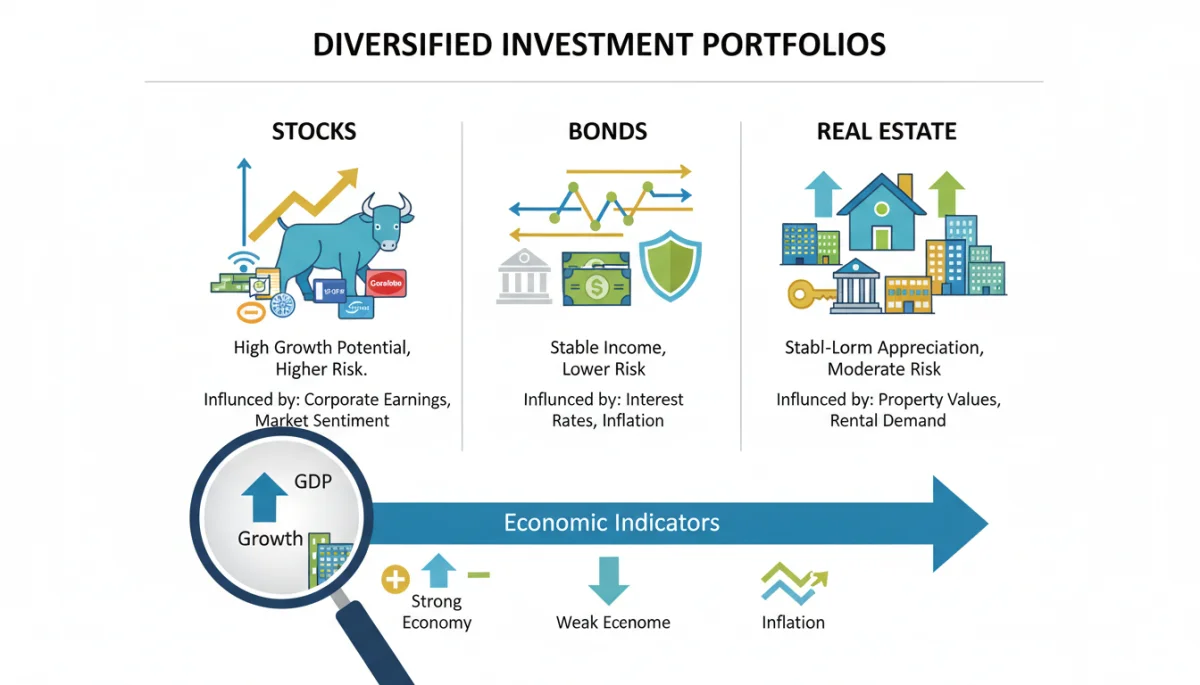
- Asset class allocation: Maintain a balanced allocation between equities, fixed income, real estate, and potentially alternative assets, adjusting based on risk tolerance and market outlook.
- Regular rebalancing: Periodically review and rebalance your portfolio to ensure it remains aligned with your investment objectives and risk profile, especially as market conditions evolve.
In conclusion, a proactive approach to risk management and robust diversification will be key to navigating the 2026 economic forecast. By spreading investments across various asset classes, sectors, and geographies, and staying vigilant about market changes, investors can build a resilient portfolio capable of generating consistent returns even in an environment of 2% GDP growth.
long-term investment outlook beyond 2026: sustained growth?
While the 2026 economic forecast projects a 2% GDP growth, it’s essential for investors to consider the long-term outlook beyond this immediate horizon. The trajectory of sustained growth will depend on several structural factors, including demographic shifts, technological innovation, global trade dynamics, and policy decisions. A 2% growth rate in 2026 could be a stepping stone towards either accelerated expansion or a prolonged period of moderate growth, influencing investment strategies for decades to come.
Demographic trends, such as an aging population in many developed economies, could impact labor supply and consumer demand, potentially moderating long-term growth. However, continuous technological advancements, particularly in areas like AI, quantum computing, and biotechnology, have the potential to unlock significant productivity gains, offsetting some of these demographic headwinds. Understanding these macro trends is crucial for formulating investment plans that extend far beyond the immediate forecast.
factors influencing long-term economic trajectory
Several key elements will shape the long-term economic landscape and influence whether growth can be sustained beyond 2026.
- Productivity growth: Investments in automation, AI, and digital infrastructure are critical for boosting productivity and driving long-term economic expansion.
- Demographic changes: The size and composition of the workforce, as well as consumption patterns, will play a significant role in shaping future economic potential.
- Geopolitical stability and trade: A stable global political environment and open trade policies are essential for fostering international investment and economic cooperation.
- Environmental and climate policies: The transition to a green economy will create new industries and investment opportunities while also posing challenges for traditional sectors.
In conclusion, while the 2026 economic forecast provides a snapshot, successful long-term investing requires a broader perspective. Investors should continuously monitor structural economic shifts, technological breakthroughs, and policy developments to adapt their strategies. A diversified and flexible approach, grounded in a deep understanding of these long-term drivers, will be crucial for capturing sustained growth opportunities well beyond 2026.
| Key Point | Brief Description |
|---|---|
| 2026 GDP Growth | Projected at 2%, indicating moderate economic expansion and stability. |
| Investment Strategy | Focus on quality, diversification, and companies with strong fundamentals in stable sectors. |
| Key Sectors | Technology (AI, cloud), Healthcare, Consumer Staples, and certain Real Estate segments. |
| Risk Management | Geographic, sectoral, and asset class diversification are crucial for portfolio resilience. |
frequently asked questions about the 2026 economic outlook
A 2% GDP growth suggests a moderately expanding economy. For average investors, this means less volatile but still positive market conditions. Focus shifts to stable, quality investments rather than high-risk, high-reward ventures. Diversification and careful sector selection become even more critical for achieving consistent returns.
Sectors like healthcare, consumer staples, and essential technology (e.g., cloud computing, AI infrastructure) are expected to perform well. These industries tend to be more resilient during moderate growth periods due to consistent demand. Investors should also look for companies with strong competitive advantages and sustainable business models.
Yes, fixed income investments should be reviewed. A 2% GDP growth implies potentially stable interest rates, making high-quality corporate and government bonds attractive for capital preservation and steady income. Consider diversifying across different bond durations and exploring inflation-protected securities to hedge against minor price increases.
Real estate should remain a stable asset class. Moderate GDP growth supports consistent demand for both residential and commercial properties, particularly in growing urban areas or specialized segments like industrial and healthcare facilities. Avoid highly speculative real estate ventures and focus on properties with strong underlying fundamentals and income potential.
Key risks include unforeseen geopolitical events, persistent inflationary pressures requiring aggressive central bank action, and significant disruptions to global supply chains. Domestic policy shifts or a sudden downturn in consumer confidence could also challenge the 2% GDP growth projection. Diversification and vigilance are crucial for mitigating these risks.
conclusion
The 2026 economic forecast, characterized by a projected 2% GDP growth, signals a period of moderate but steady expansion. This environment demands a strategic and discerning approach from investors, emphasizing quality, diversification, and a deep understanding of sector-specific dynamics. While broad market gains may be less pronounced, opportunities abound in resilient industries and innovative technologies. By focusing on strong fundamentals, managing risks through robust diversification, and adapting to evolving trends, investors can position their portfolios for sustained success, ensuring their investments thrive in this measured economic landscape.